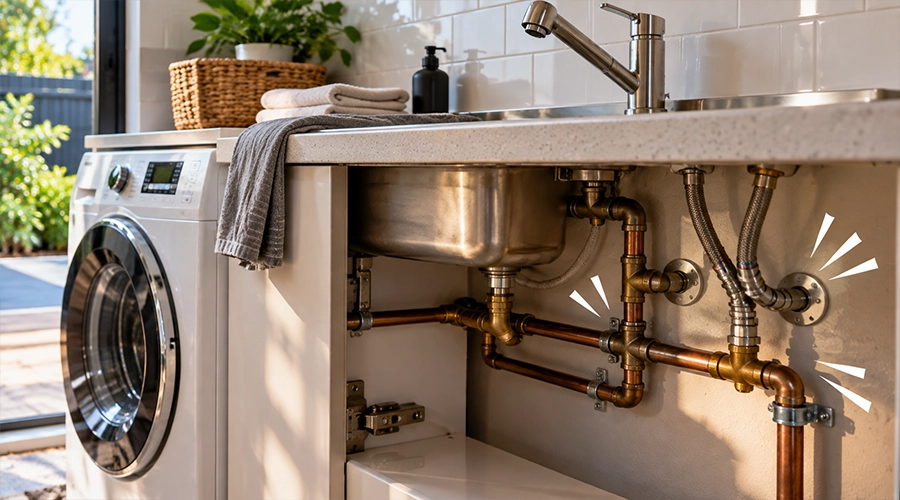
Somebody turns off the laundry tap and the wall thumps. Water hammer in a Hills District home sounds alarming, and the noise is doing more than annoying everyone. Each bang is a shockwave travelling through the pipework.
Most households learn to ignore it. Pipes bang, life goes on. Yet the cause is usually fixable in a single visit. Leaving it alone shortens the life of every fitting in the house.
What is water hammer, and why does it bang?
Water hammer is a pressure surge created when moving water stops suddenly. The water has weight and momentum. Shut a valve quickly and all that momentum hits a closed door.
Nothing absorbs the impact, so the energy travels back along the pipe as a shockwave. What the house hears is the pipe moving against timber, brick or a bracket. The bang is the collision, not the water itself.
Why does it happen when a tap or appliance shuts off?
Because closing a valve is the fastest thing that happens in a plumbing system. A tap turned off by hand still takes a second or two, which softens the stop.
Appliance valves close in a fraction of that. Solenoid valves, the electrically operated kind inside a washing machine or dishwasher, snap shut almost instantly. Faster closure means a sharper surge.
Why do washing machines and dishwashers trigger it most?
Those appliances fill in bursts, cycling the valve open and shut repeatedly through a wash. One load produces dozens of closures.
A dishwasher mid cycle often gives the game away. Nobody is touching a tap, and the pipes bang anyway. That points at an appliance rather than a worn tap washer, and it narrows down where a plumber starts looking.
Is water hammer actually damaging?
Yes, though the damage builds slowly rather than arriving all at once. Repeated surges work on joints, fittings and connections that were never meant to flex.
Braided flexible hoses under sinks and vanities take a beating from it. Those hoses already cause plenty of household flooding on their own. Surges also loosen fixings over time, which lets pipes move further and bang harder. The problem compounds.
Sydney Water takes the underlying pressure seriously enough to run a program about it. High water pressure leads to breaks in water pipes and leaks across its network. A house with banging pipes and high incoming pressure has both halves of that problem.
What causes it in a particular Hills District home?
Three things, usually in combination. A plumber works through them in order rather than guessing.
Is the water pressure too high?
Often, yes. Sydney Water’s operating licence sets a minimum of 15 metres head at the point of connection. Its network average sits at 52 metres head, and some properties receive more than 100.
Pressure that high makes every surge stronger. A pressure limiting valve near the meter holds incoming pressure down to something the house can live with. Building Commission NSW expects installers to test inlet pressure and fit one of these valves where required. Standard practice, in other words, rather than an upsell.
Are the pipes properly supported?
This is the part most people never consider. A pipe held firmly cannot move, and a pipe that cannot move cannot bang.
NATSPEC publishes technical guidance for Australian construction. It notes that supports control deflection and stress. Extra supports may be needed at bends and tees to control expansion, vibration or surges. Its spacing tables are maximums rather than targets. Pipes in a wall cavity or under a floor sometimes sit on fixings that worked loose years ago.
Could it be a worn tap or valve?
Sometimes, and it is the cheapest cause to rule out. A perished washer or a loose jumper valve lets water buffet the component. What that produces is a rattle or a shudder rather than a single thump.
Noise type helps separate the two. A sharp bang after a valve closes suggests a surge. A vibrating hum or chatter while water is running suggests something loose inside the tap.
How does a plumber fix it?
By treating the cause rather than the symptom. The fix follows whatever the inspection found.
An arrestor absorbs surges near the appliance causing them. Inside sits a sealed air chamber that compresses as the shockwave arrives. A pressure limiting valve lowers pressure for the whole house. Refixing or adding pipe supports stops movement where pipes have worked loose. Replacing worn tap components fixes the rattling kind.
More than one of those often applies. An arrestor fitted to a house running 90 metres head of pressure treats one symptom and leaves the cause.
What can a homeowner check first?
Two things, and both take minutes. Neither requires tools.
Note which fixture or appliance triggers the noise, and whether it happens on opening or closing. Then test the pressure using Sydney Water’s method. Turn everything off and read the meter. Run the front garden tap fully for one minute, then read the meter again. Sydney Water expects around 18 litres a minute at the garden tap from its minimum pressure.
A reading well above that suggests pressure worth measuring properly with a gauge. Both answers save time on the callout, and the same logic applies when pressure runs the other way.
Banging pipes rarely fix themselves. The cost of ignoring them turns up later as a failed fitting or a flooded cupboard. Sweeney’s Plumbing works across the Hills District from its Seven Hills office. Free cost estimates come first, for approval before anything starts, and repair work carries a 12 month guarantee. To get the noise diagnosed properly, get in touch or call 1800 219 682.