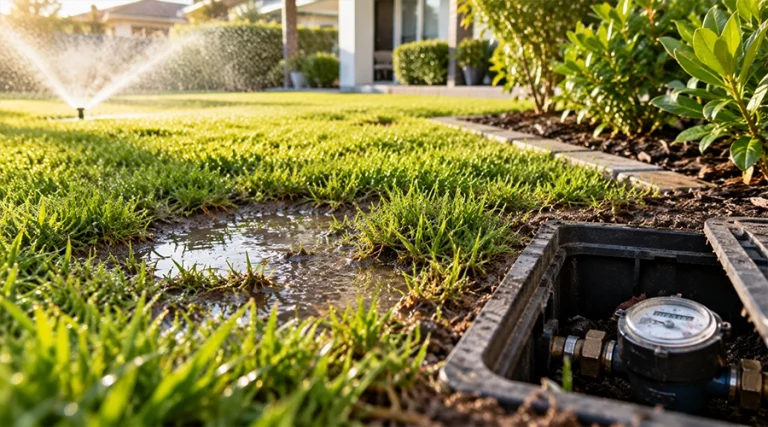
A long dry stretch does not feel like a plumbing problem. Lawns brown off, gardens struggle, and nobody gives the sewer line a thought. Yet dry weather drain problems in the Hills District peak after weeks without rain, not after a storm.
Timing makes it worth a look right now. The Bureau of Meteorology reports a strong El Nino. Its central Pacific index sits well above the El Nino threshold, and models expect the event to last into autumn 2027. A strong Pacific signal does not guarantee a dry Sydney summer, as the Bureau points out. It is still a fair prompt to check a drain that has given trouble before.
What causes dry weather drain problems in the Hills District?
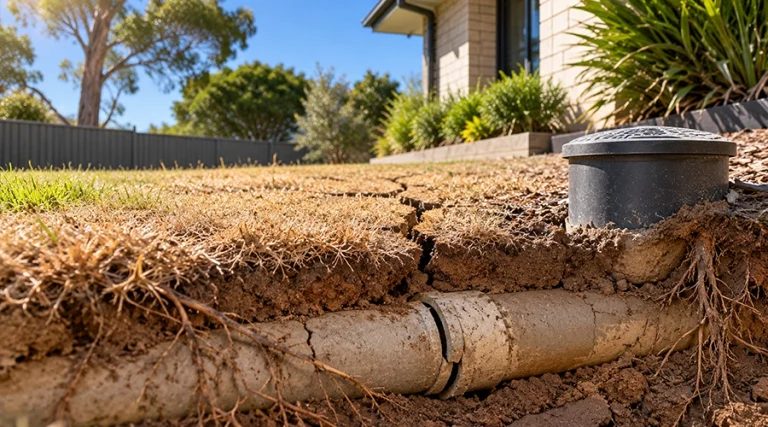
Ground movement causes them. Soil shrinks as it dries out, then swells again when rain returns, and buried pipes shift with it.
That movement is rarely even across a block. Paving and slabs hold moisture in the soil beneath them, while open lawn dries out fast. Large trees pull water from one side of a garden and not the other. Uneven movement does the damage, not movement on its own.
Which ground moves the most?
Soil with a high clay content moves the most, because clay gives up and takes on moisture in a way sandy soil does not. Building Commission NSW groups the worst of it under ground that is other than stable, alongside filled and water charged ground. Soil classes H1, H2 and E fall in the same category.
Worth being clear about one thing here. Reactive soil describes the ground around a pipe, not the pipe itself. A property can sit on reactive ground whatever its drains are made of.
Every new home gets a site classification, and it appears in the engineering paperwork for the footings or slab. Owners who still hold the soil report from the build can look it up. A geotechnical engineer can test the site for anyone who cannot.
How does that movement reach the drain?
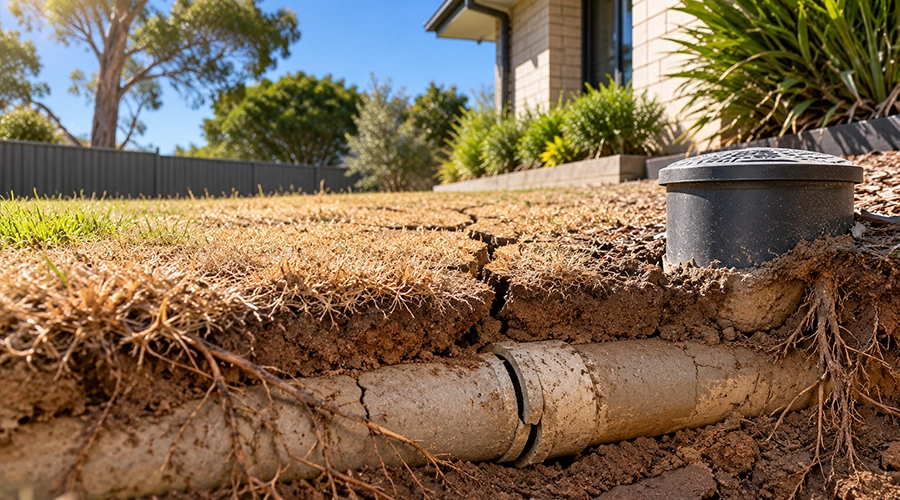
Through the joints. A sewer drain sits in a trench, often under paving or close to the slab edge. When soil drops away unevenly, the pipe loses its support. Load then concentrates at the weakest point, which is almost always a joint. An opening of a few millimetres is enough to matter.
Current rules recognise the risk. Building Commission NSW requires flexible joints in drains laid in filled, unstable or water charged ground. Soil classes H1, H2 and E count too. A flexible joint is a fitting that takes up ground movement without breaking the seal. That requirement governs work carried out now, and a drain laid decades ago never had to meet it.
How can anyone tell what their pipes are made of?
Not from above ground, in most cases. Nothing visible at the gully or the inspection opening says much about a line running under the lawn.
House age gives a rough steer. Older drains tend to come in short sections, with many joints along a single run. One common material behind that pattern is earthenware, a glazed clay pipe used widely last century. Newer work generally runs PVC in longer lengths with fewer connections, which tolerates a little flex. Either way, a camera is the only reliable way to find out what is down there.
Depth plays a part too. A line under a driveway or a slab carries load from above as well as movement from below. That combination sits behind many cases of a pipe failing under concrete.
Why do tree roots find the crack so quickly?
Because roots follow moisture, and during a dry summer a sewer line is the wettest thing in the yard. A hairline gap releases vapour into the surrounding soil. Roots grow towards it, fine hairs slip through, and those hairs thicken once they reach the water inside. Sydney Water describes roots pushing through small cracks in search of nutrients. Once inside, they keep growing and restrict the flow.
Root mass then catches wipes, fat and paper, so a crack ends up as a solid plug.
Which trees cause the most trouble near a sewer line?
Fast growing species with aggressive root systems. Sydney Water publishes a list of trees to avoid near wastewater pipes. Eucalypts, figs, willows, poplars and bamboo all appear on it. Sydney Water also suggests planting six metres clear of a wastewater pipe, and checking where pipes run beforehand.
Plenty of Hills gardens went in long before anyone checked a pipe diagram. A mature tree and a problem drain often share a block for that reason. Root activity also picks up as the weather warms.
What are the signs a drain has moved rather than simply blocked?
Repetition is the clearest sign. An ordinary blockage clears and stays clear. A damaged drain blocks again in the same spot, sometimes within months.
Other signals are easy to miss:
- a toilet or floor waste that gurgles when the shower empties
- one end of the house draining slowly while the rest behaves normally
- a faint smell near an outdoor gully on warm afternoons
- a strip of lawn that stays green while everything around it browns off
That last one matters most in a dry summer. Grass finds the water before anyone else does.
Why does the same drain keep blocking after a clean?
Because a clean removes the blockage and not the opening that let it start. High pressure jetting cuts roots out and restores flow, and Sweeney’s Plumbing runs it on pipelines from 100 mm up to 450 mm. Roots then regrow through the same gap, because the gap is still there.
Finding the gap is a separate job. A camera run through the line shows what is actually wrong. It picks up a crack, a dropped joint, a sag in the pipe or a full collapse. It also pins down how far along the run the fault sits, and that distance shapes both the repair and the price.
What can be repaired, and who pays?
A plumber can repair most movement damage from inside the pipe. The owner pays for the section that sits on their own land.
Can a plumber fix the pipe without digging up the yard?
Usually, yes. A liner or a patch bonds to the inside of the existing pipe and seals the opening, so roots lose their way in. Sweeney’s Plumbing fits patches from 300 mm up to 1500 mm long. That covers most single cracks and dropped joints without excavation, and lawn, paving and driveways stay where they are.
Collapsed pipe is a different story. Once a section loses its shape, nothing remains to line, so that length has to come out. A camera inspection tells the two situations apart. Worth doing before anyone quotes on a dig.
Where does the property owner’s responsibility end?
At the point of connection to Sydney Water’s network. Sydney Water states that the property owner is responsible for their connection to the wastewater system. A licensed plumber has to carry out work on that private section.
A few exceptions exist, and they are worth knowing about. Sydney Water may cover the repair where:
- its own junction has failed
- its crew damaged a junction while clearing roots
- the point of connection needs excavation deeper than 2.5 metres
Each one depends on an investigation, so camera footage is useful before making any claim.
Dry weather drain problems in the Hills District rarely sort themselves out. The season does suit the work, though. Ground is firm, access is easy, and a line that has been shifting all summer turns up now rather than after the first real downpour. Sweeney’s Plumbing covers the Hills District from its Seven Hills office, with free cost estimates for approval before anything starts. A drain that keeps coming back deserves a proper look, so get in touch or call 1800 219 682.